
Prevention is better than a cure
Speak to our teamA UPS with worn batteries looks exactly like a UPS that is working. The display is normal, the load is protected from everything except the one event the system exists for, and nothing tells you otherwise until the mains goes and the runtime is thirty seconds instead of fifteen minutes.
Degradation is not linear
Capacity declines slowly for years, then falls away quickly near the end of life. By the time the loss is obvious there is very little margin left, which is why waiting for a symptom is waiting too long.
The alarm comes late
A battery fault or end of life alarm tells you the batteries have already fallen below a usable threshold. It is a notification of a problem, not an early warning of one.
Planned costs less than unplanned
A scheduled replacement is a budget line and a booked visit. An unscheduled one is an emergency callout, an engineer at short notice, and whatever the outage itself cost you.
Replace on a schedule, not on a symptom. It is the single cheapest thing you can do to keep a UPS doing its job.
Any one of these is enough. Age alone is enough.
Three years or more
The strongest signal, and the one that arrives before any symptom.
Runtime has dropped
Noticeably shorter than it used to be, after a full recharge.
A failed battery test
Scheduled or manual, a failure is a result, not a glitch.
Swollen, leaking or hot
Take the unit out of service immediately, whatever its age.
Uniti Power UPS batteries are specified with a three to five year design life. Plan replacement at three to four years, and treat five as the point at which you are running on borrowed time rather than the target.
The clock
Design life assumes a reasonable environment. It is a specification, not a promise, and the conditions below move it in one direction only.
What shortens it
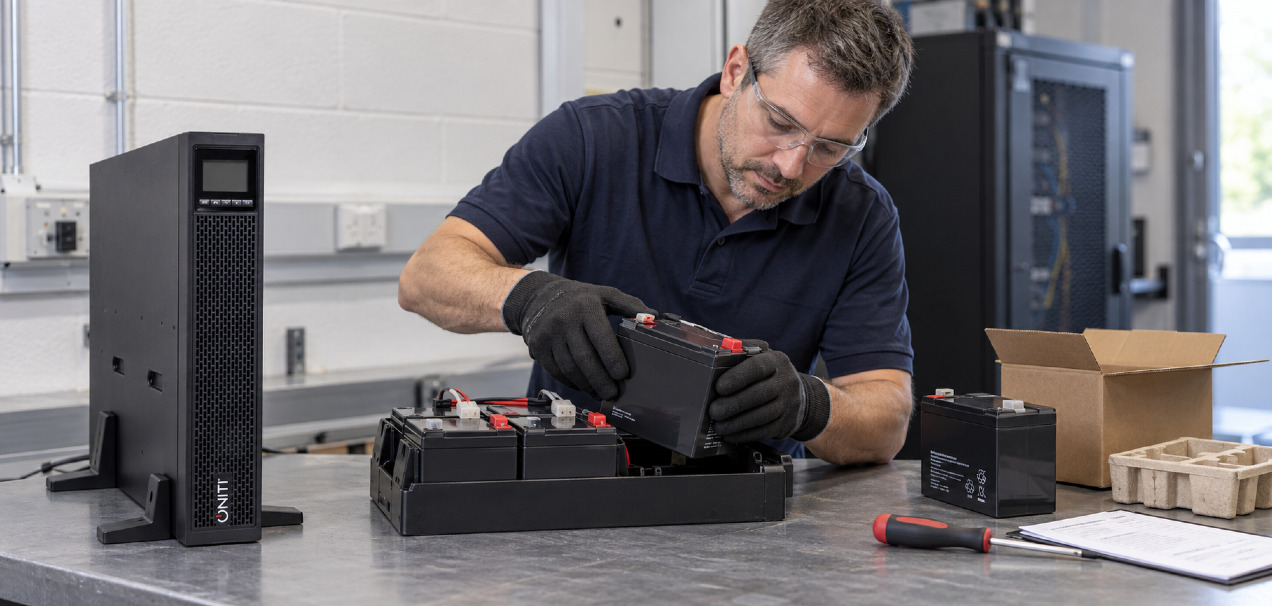
We design the systems, so we supply the batteries for them as matched kits rather than as a compatible equivalent. A replacement puts the unit back to its original specification, with the runtime the datasheet promised.
URBK
Uniti replacement battery kits
A matched set supplied under one part number, so the correct type, rating and quantity arrive together rather than being assembled from individual cells.
Quote the model and serial number of the unit when ordering. The correct kit depends on the exact variant and, on some units, how it was configured at installation.
EBM
External battery modules
Where the answer is more runtime rather than the same runtime restored, external battery modules extend a Symphony or Echo system without replacing the UPS.
If the load has grown since installation, replacing like for like restores the old runtime against a bigger load. Ask before assuming the original specification still fits.
Why matched kits matter
Mixing battery types, capacities or ages within a string is unsafe, gives unpredictable runtime and affects your warranty cover. Batteries in a string share the load and age together; introducing a new cell alongside worn ones drags the new one down to the condition of the old. Replacing the set is not an upsell, it is the only way the arithmetic works.
Replacements must be the same type, rating and quantity as those originally fitted. That condition appears in our warranty terms, and a matched kit satisfies it without anybody having to check.
Replacement is arranged through your partner
Uniti Power makes the matched kits. Your approved partner supplies them, fits them and takes the old set away for recycling, usually as part of a planned maintenance visit rather than a separate job.
What happens to the old batteries
UPS batteries are recyclable and are covered by battery and waste regulations that differ by territory. They must never go in general waste. Collection and recycling is normally handled as part of the replacement visit, so the old set leaves site with the engineer who fitted the new one.
Because the alarm is a late signal. It fires when the batteries have already dropped below a usable threshold, which means the system has been carrying less protection than you thought for some time before it told you.
Age is a better guide than alarms. If the batteries are past three years, plan the replacement rather than waiting to be prompted.
If the UPS has been in service since new and the batteries have never been changed, the install date is the answer. If you registered the product, the date of purchase is on record against the serial number.
Otherwise, batteries usually carry a date code, and a maintenance visit will establish both the age and the current condition.
No. Batteries in a string work as a set, and a new cell placed alongside worn ones is pulled down to their condition rather than lifting them to its own. You get a fraction of the life you paid for and an unpredictable runtime.
Replace the set. It is also a condition of warranty cover that replacements match the type, rating and quantity originally fitted.
Many units have user-replaceable battery packs behind a front panel, and on hot-swappable models that can be done without dropping the load. Follow the procedure in the manual for your model.
Larger installations, anything hard wired, and anything you are not completely comfortable with should go to your partner. Batteries hold a charge whether or not the unit is switched off.
Against the original load, yes. A matched kit puts the unit back to its specified capacity.
Against today's load, possibly not. Most installations have grown since they went in, and the same battery capacity supporting more equipment gives less time. If the load has changed materially, it is worth checking the sizing at the same time rather than restoring a figure that no longer applies.
Replacing them correctly protects it. Cover requires the system to be maintained in line with our guidance, and replacements to match the type, rating and quantity originally supplied.
Batteries are consumable components and carry their own warranty period, separate from the UPS electronics. The periods for each range are on the warranty page.
Find a partner
Who supplies and fits replacement kits in your territory.
Find a partner →UPS maintenance
Health checks and battery testing, so replacement is scheduled rather than reactive.
Maintenance and support →Not sure which kit?
Send us the model and serial number and we will identify the right one.
Ask an engineer →
Prevention is better than a cure
Speak to our team