
Prevention is better than a cure
Speak to our teamA UPS spends almost all of its life doing nothing visible. That is the problem: a system that has quietly stopped being able to support the load looks exactly like one that is working, right up until the moment it matters. Most failures we are called about were detectable months earlier.
Find faults before they find you
Battery degradation, capacitor ageing and overload conditions all announce themselves well in advance if somebody is looking.
Get the life you paid for
Heat, dust and blocked ventilation shorten equipment life more than use does. A visit catches the installation problems nobody notices from a desk.
Know your real runtime
Runtime falls as load grows and batteries age. Testing tells you what you actually have now, rather than what the datasheet said on the day it was installed.
Plan the spend
A planned battery replacement is a budget line. An unplanned one is an emergency callout, a site visit and whatever the outage cost you.
A visit that produces a tick in a box has told you nothing. These are the things that actually establish condition.
Visual inspection
Wear, damage, and the installation problems nobody notices from a desk.
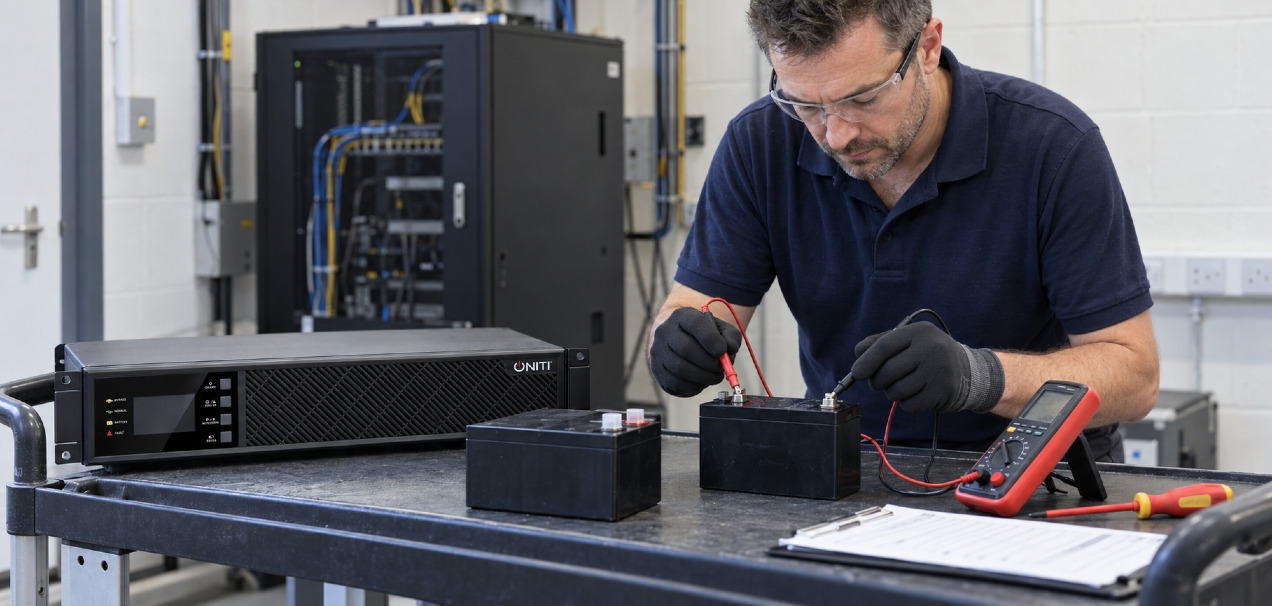
Battery testing
Measured against expected performance, not against how it looks.
Bypass and controls
External bypass checked where fitted, settings and event log reviewed.
Written report
What was found, what it needs next, and when.
Three areas of service, delivered by the partner covering your territory and supported by our own engineers.
Planned
Health check
A scheduled visit that establishes what condition the system is genuinely in, and what it will need next.
Reactive
Emergency callout
For when the load is down or running unprotected and it cannot wait for the next scheduled visit.
Before you call, the fault reporting page lists the checks worth running first. A fair share of callouts turn out to be the supply or the load rather than the UPS.
Lifecycle
Battery services
Batteries are consumable. They are also the single most common reason a UPS fails to support its load.
Uniti Power supplies matched replacement battery kits for our own systems, so a replacement restores the original specification rather than approximating it.
Maintenance contracts are arranged with your partner, and typically build up in three steps. What each level is called, and exactly what it includes, varies by partner and territory.
Warranty assistance applies to systems with cover still in force. See warranty information for the periods that apply to each range.
Most partners will build cover around the site rather than sell you a fixed package.
Guaranteed response times
A committed window for an engineer to make contact and establish whether an attendance is needed. Tighter windows suit hospitals, data centres and anywhere an outage is measured in more than inconvenience.
Additional visits
More than one preventative visit a year. Worth considering for older systems, and for anywhere dusty, warm or subject to large temperature swings.
Out of hours visits
Scheduled work carried out in the evening or at a weekend, so a maintenance visit does not become an outage of its own.
Battery impedance testing
Measures internal resistance to identify cells that are declining before they fail, which turns battery replacement into something you schedule rather than react to.
Connected monitoring
UPNETG2 and WinPower G2 are included with our systems. A monitored estate tells you about a condition when it appears, not at the next visit.
Multi-year agreements
Longer terms usually carry better rates and protect against price movement, which makes budgeting across an estate considerably easier.
Maintenance runs through your partner
Uniti Power designs and builds the systems. Our approved partners hold the maintenance contract, attend site and quote the work, trained on our range and backed by our engineers when something needs escalating. One conversation, not two.
Once a year is the usual baseline for a system in a clean, temperature-controlled room carrying a steady load.
Twice a year is sensible where the environment is warm, dusty or subject to large temperature swings, where the system is more than a few years old, or where the load has grown since installation. If an outage would stop the organisation working, err towards more often.
A visual inspection of the unit and its installation, battery testing, a check of the external bypass where one is fitted, cleaning and servicing including ventilation, a review of the event log, and a written report setting out what was found and what it needs next.
The report is the part that matters. A visit that produces a tick in a box has told you nothing.
The electronics typically give ten years or more in a reasonable environment. The batteries will not, and that is the distinction people miss.
Echo batteries are rated at around 300 cycles or two to three years, Symphony batteries at three to five years with replacement normally planned at four. Expect to replace batteries at least once, and probably twice, over the life of the unit.
Ageing batteries, by a considerable margin. After that: overload from equipment added since installation, heat from poor ventilation or a room that has filled up, and dust.
Genuine electronic failure is comparatively rare, and when it does happen it is often downstream of one of the above having been left alone for a long time.
An alarm or fault code on the display, a failed battery test, runtime noticeably shorter than it used to be, transferring to battery when the mains supply appears to be fine, or the unit running hot.
Anything visibly swollen, leaking or hot should be taken out of service straight away.
Our approved partners. They hold the contract, attend site and quote the work, and they are trained on our systems and backed by our own engineers when something needs escalating.
Uniti Power does not sell maintenance direct, but you can come to us at any point for technical advice on a system you own, whoever you bought it from.
Warranty cover requires the system to have been installed, operated and maintained in line with our guidance and the manual for the model. Servicing it properly is part of keeping cover valid, not an optional extra alongside it.
Find a partner
Who covers your territory, and who to talk to about a maintenance contract.
Find a partner →Site survey
For estates that have grown past the protection put in for them, or where nobody is quite sure what is installed.
Request a survey →Technical support
Questions about a system you already own, whoever you bought it from.
Ask an engineer →
Prevention is better than a cure
Speak to our team