
Prevention is better than a cure
Speak to our teamNot every system does. Knowing which side of the line yours falls on is worth two minutes before anything is ordered, because it changes the lead time, the cost and who needs to be on site.
Straightforward
Plugs into a standard socket
Smaller tower and rack units connect to an ordinary supply and can be set up by any competent person following the manual.
Commissioning is still worth having. Correctly configured is not the same as switched on.
Needs a qualified electrician
Hardwired, or anything beyond a socket
Larger systems, including Symphony 6kVA and above, are hardwired. These, and anything else that touches fixed wiring, must be installed by someone qualified to do it.
Installation outside the manufacturer's instructions can affect warranty cover, so this is not the place to improvise.
A commissioning visit that stalls waiting for a network port is a wasted day. Four things to have ready.
The circuit
In place and tested, sized for the model being installed.
The space
Cleared, with the clearance the manual requires, and access sorted for heavy equipment.
Network details
An IP address for the card, and whoever manages the firewall reachable.
Someone who can decide
A person on site who can say what must not be interrupted.
Getting the equipment in, connected and physically right. Most of what goes wrong later is decided here.
Electrical work
Supply, circuit and earthing arrangement confirmed against the requirement for the model, and the connection made to current regulations.
Physical installation
Rack mounting or floor positioning, with the clearance the manual requires. Batteries are heavy and sit low, so floor and rack loading are checked rather than assumed.
Battery modules
External battery modules connected in the correct order and the UPS told how many are fitted, so it charges them properly and calculates remaining runtime correctly.
Bypass and EPO
External maintenance bypass wired and proved, and emergency power off either wired to the building system or left with its jumper in place.
Load connection
Equipment moved onto the protected supply deliberately, with the load checked against the rating rather than discovered afterwards.
Environment
Ventilation, intake temperature and dust assessed. Heat is the largest single factor in how long the batteries will last, and it is set on installation day.
Installation puts the system in. Commissioning proves it does what it was bought to do, and sets it up for the load it is actually protecting rather than the defaults it shipped with. These are the steps that matter on Uniti Power equipment specifically.
Register the product at handover while the serial number and date of purchase are in front of you. Warranty registration →
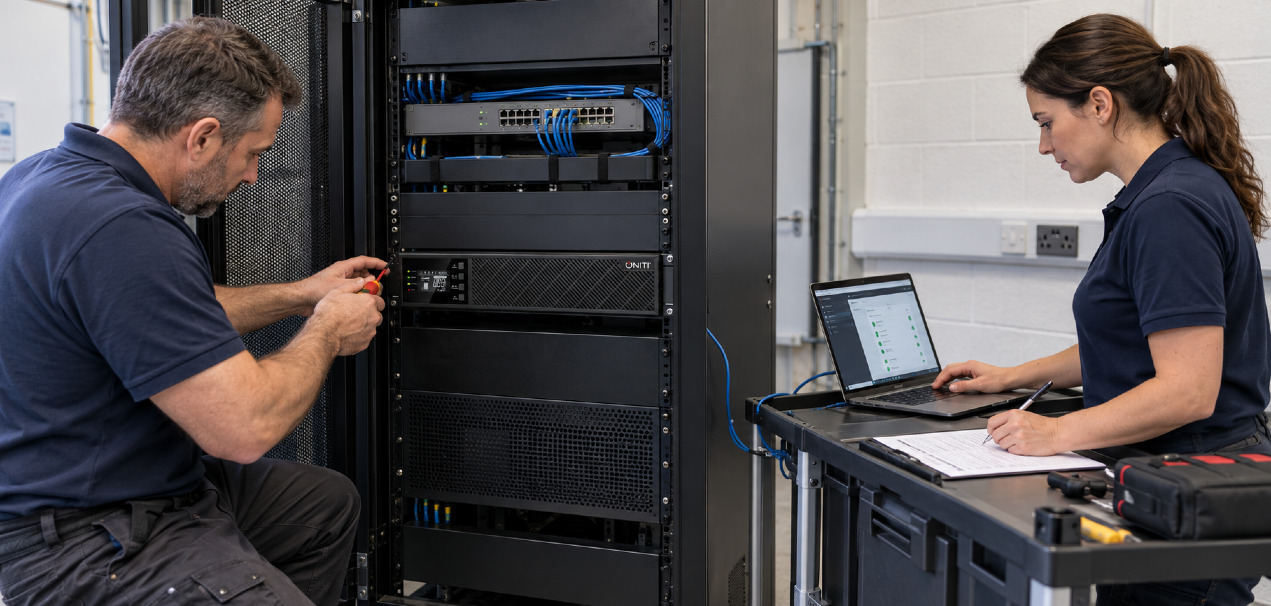
Installed and commissioned by your partner
Uniti Power writes the installation and commissioning guidance. Our approved partners carry it out, trained on the range and backed by our engineers, so the system is set up for the load it is actually protecting rather than left on its defaults.
Installation and your warranty
Warranty cover requires the system to have been installed, operated and maintained in accordance with Uniti Power guidance and the manual for the model, by someone competent to do the work. Incorrect installation, including supply or earthing arrangements outside specification, is an exclusion.
This is not a technicality invented to avoid claims. Most of what shortens the life of a UPS is decided at installation: where it sits, how warm it gets, whether the ventilation is clear, and whether the supply feeding it is what the unit expects.
Commissioning is recommended on every Uniti Power system and strongly recommended on hardwired and parallel installations, but on the current range it is not a condition of warranty cover.
Installation gets the system in place, connected and physically correct. Commissioning proves it works and configures it for the load it is actually protecting.
A system can be perfectly installed and still be wrong: default settings, no battery test scheduled, alerts going nowhere and a shutdown plan nobody has run. Commissioning is what closes that gap.
For a small unit plugged into a socket, no. Follow the manual, allow the first charge, and you have a working system.
For anything hardwired, anything with external battery modules, anything in parallel, and anywhere an outage carries real cost, we strongly recommend it. It is not a condition of the warranty, but the value is in having a measured runtime figure and a proved shutdown plan on the record from day one.
The circuit in place, the space clear with the required clearance, access sorted for getting heavy equipment in, and somebody available who can say what must not be interrupted.
For the network side: an IP address for the card, and whoever manages the firewall reachable. A commissioning visit that stalls waiting for a network port is a wasted day.
Yes, and it is worth doing on an estate nobody has looked at for a few years. It usually turns up default settings never changed, battery tests never enabled, alerts pointing at someone who left, and a runtime figure quite different from what people assume.
On an older installation this often overlaps with a site survey, which takes in the whole estate rather than one unit.
Find a partner
Who installs and commissions Uniti Power systems in your territory.
Find a partner →Site survey
Before you order, if the load, the supply or the space is not settled.
Request a survey →Quick start guides
Setting one up yourself: connection order, first charge and what the panel is telling you.
Read the guides →
Prevention is better than a cure
Speak to our team